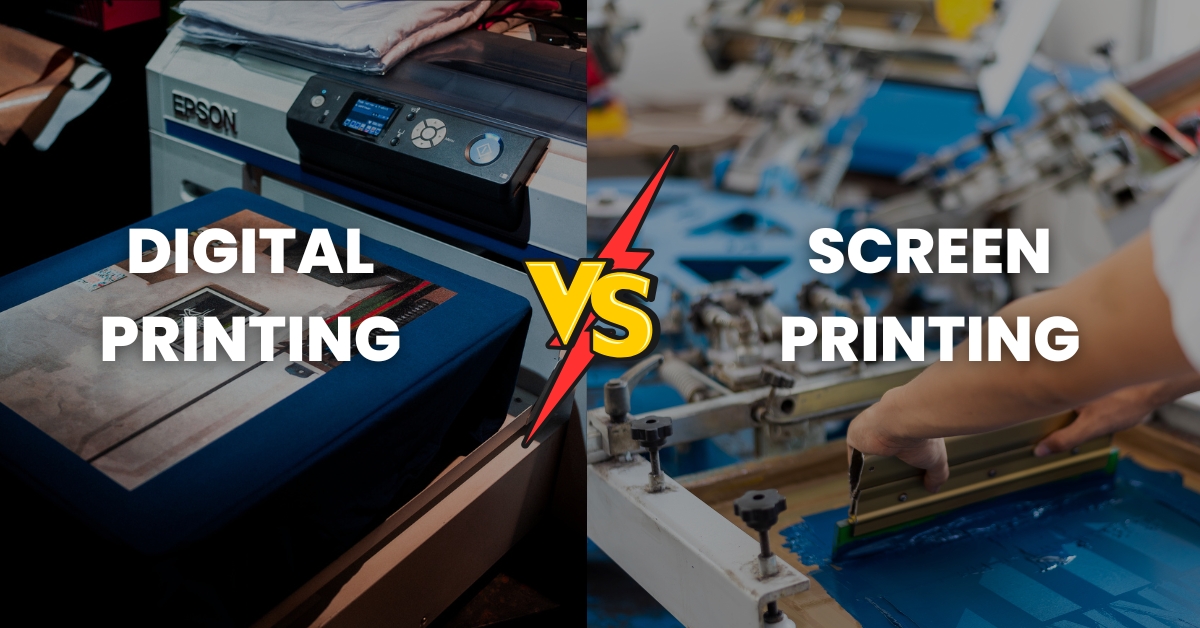
Choosing the best printing process can make or break your product packaging, merchandise, or promotional product. Two of the most popular processes—screen printing and digital printing—both have their advantages and disadvantages. But which is best for your project?
In this article, we’ll explore Screen Printing vs. Digital Printing in detail to help you make a well-informed decision based on your specific needs.
We shall describe both processes in detail to allow you to make a well-informed decision.
Table of Contents
ToggleWhat Is Screen Printing?
Screen printing, or silkscreen printing, is an older technique that employs a stencil (or screen) and ink to print designs on a surface. You employ a separate screen for each color in your design.
Suitable for:
- Bulk orders
- Designs with limited colors
- Permanent markings on fabrics and paper-like substrates
What Is Digital Printing?
Digital printing is printing from a digital file to numerous varieties of materials with the latest laser or inkjet printers. It is a newer process that does not use screens or stencils.
Appropriate for:
- Small and medium-sized orders
- Very intricate, painted patterns
- Quick turnaround times
Advantages and Disadvantages of Screen Printing
Advantages:
- Affordable for large quantities
- Long-lasting and vibrant prints
- Performs well on several surfaces, particularly fabrics
Disadvantages:
- Not suitable for small lands
- Moderate color mixing
- Additional setup time
Advantages and Disadvantages of Digital Printing
Advantages:
- Ideal for short runs
- Detailed information
- Faster installation with less waste
Disadvantages:
- More expensive for bulk printing
- Can fade progressively over time on clothing
- Limited material compatibility
Important Points to Consider Prior to Selection
1. Order Quantity
For larger quantities (i.e., >500 t-shirts), screen print will be cost-effective because of lower cost per unit. If you have just 10-50 units, digital print would be time-and-initial-setup-reducing in nature.
2. Design Complexity
Detailed illustrations or gradient shading? Screen printing would accomplish that better than digital printing. But for simple logo-based designs, screen printing yields more solid results.
3. Material Type
Though both techniques can be used on paper, tote bags, and t-shirts, screen printing is more suitable for use on materials like wood, metal, or glass. Digital printers can tolerate only flat surfaces as a limitation.
4. Timeline and Budget
Screen printing takes more preparation time, so it’s more time-consuming for rush orders. For a lower quantity rush order, use digital. For an ongoing project that has a higher budget, screen printing is justified for longevity and cost per unit.
Which Printing Method Is Right for You?
- Choose screen printing if you have lots of items, not many colors, and want a tough, high-quality finish—perfect for shirts, signs, or promotions.
- Choose digital printing if you need to print small runs, fine details, or fast turnaround—ideal for personalized gifts, new business identity, or test product trials.
Final Thoughts
Understanding the difference between screen printing and digital printing will save you time, money, and frustration. Both have their uses, and what you choose should depend on the size, design, material, and deadline of the project. Regardless of whether you’re a business owner, designer, or marketing professional, using the proper printing method is key to producing professional, attention-grabbing results.


Add comment